Game updates, world events, and news from Aetolia - delivered to your inbox.
Name Please enter your name. Email Please enter a valid email address.Unsubscribe at any time via the link at the bottom of any email.
Ogre
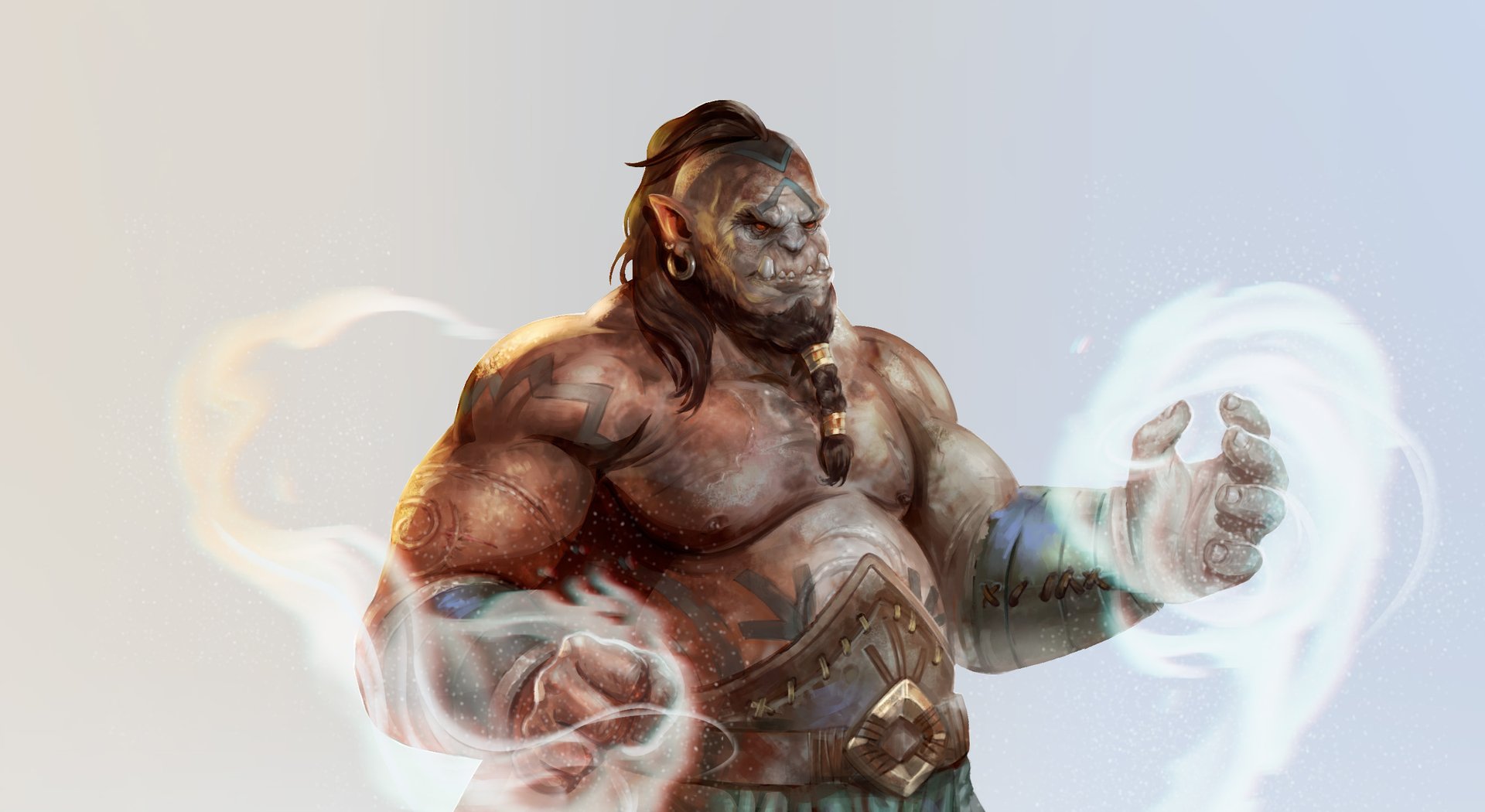
Massive in height and girth, Ogres have black, beady eyes and skin that displays in hues of stone grey – a characteristic that allows them to blend in with the walls of caves, the sides of mountains, and other rocky outcroppings. They possess angular, imposing features that set them apart from many other humanoid races.
At a glance
| Feature | Details |
|---|---|
| Appearance | Massive humanoids with stone-grey skin, black eyes and angular features. |
| Origins and communities | Historical roots in caves and Dun Valley; later dispersed after the Indorani Empire fell. |
| Culture | Religious and magical traditions, particular reverence for the earth, and inherited scarification practices. |
| Racial abilities | Brawler; Sturdiness; Overcome |
Origins and history
The Ogres, like their cousin Orcs, bear a distant relation to the Trolls, all three races created through the machinations of the Goddess of Corruption sometime in the First Mortal Epoch. The Ogres were cave-dwellers to begin with, and preyed on travellers passing along roads that cut through the territories they held. Eventually travelling to Dun with the Orcs early in the First Mortal Epoch, the Ogres used their size and strength to intimidate and crush the valley’s Humans.
Ogres were used as shock troops by the Indorani Empire, who found their size and lumbering gait ideal for the work of enslavement and subjugation they desired. Many served in the military, alongside Orcs, and when the Empire collapsed they, too, were left destitute and villainised by the other humanoid races.
Religion and magic
The Ogres, while associated with the Orcish proclivity for warfare, tended to devote their intelligence to other matters; many Ogres were devoutly religious, paying homage to many Gods among the pantheon and revering the earth in particular. Through their travels, they gathered a wide variety of interpretations of the Aetolian pantheon, influenced by the Theran Humans, Salurian Rajamalans, Ophidians, Xorani, and others. Because of this, of the two cultures that arose in Dun, the Ogres preferred religion and magic despite their great size.
Scarification
Men of the Ogre race are distinguished, in many cases, by ritual scarification, which is added to across a man’s lifetime. Scars endured in battle are often incorporated into the design. Designs tend to be passed down through families, though scars signifying wisdom, priesthood, and other honoured vocations are often added alongside family patterns. Scarification begins young, and its completion – often involving the administration of the most painful scars – signifies a man’s coming of age.
Though Orcs also follow this practice, the two races possess differing designs. This practice dates to the Indorani empire, when marks upon the flesh and corporal punishment were common; Orcs and Ogres, often called upon to punish their own, found resonance with Rahnite philosophy. The practice thus endured beyond the fall of the Indorani, and is still widely employed in the diaspora despite objections from more contemporary Dunnite philosophy.
Racial abilities
Level 1: Brawler
This ability is passive.
Your body is built for rough housing, tripling the power behind your basic punches and kicks.
Please see AB SURVIVAL FISTICUFFS for more information on punching and kicking.
Level 31: Sturdiness
Syntax: STAND FIRM
By concentrating on increasing your mass, you can gain immunity to most physical attempts to move you. Additionally, should you be feared, it will have no effect while you remain firm. You will lose this defence should you move.
Level 61: Overcome
Syntax: OVERCOME
Surprising blows are no match for your internal rage. With this ability, you can push through and remove your stunned state, but it will cost you 25% of your maximum health.
Cooldown: 900 seconds
Class ideas for roleplay
These are potential starting points for a character’s story and are offered as suggestions only. You can make almost any class or race combination work in Aetolia as your race gives no special advantage with these classes; availability follows the usual class and guild rules.
Teradrim
An Ogre could develop their people’s reverence for the earth into devotion to Ivoln among Bloodloch’s Apostles. Animating golems to fight or build would put that faith to work for an empire seeking to extend its rule with the Gods’ support.
Ascendril
An Ogre mage might join Enorian’s Ascendril to study fire, water and air, continuing their people’s longstanding interest in magic. They could use those arts to defend Enorian against Shadow and Corruption, seeking to make amends for their ancestors’ service to the Indorani Empire.
Indorani
An Ogre occultist could investigate the sorcery of the Empire their ancestors once served. The modern Indorani have no central guild, so they must choose what to preserve from that history and how to negotiate their own bargains with Corrupt Chaos.
See also: The Races of Aetolia · The World of Aetolia · Character Classes