Game updates, world events, and news from Aetolia - delivered to your inbox.
Name Please enter your name. Email Please enter a valid email address.Unsubscribe at any time via the link at the bottom of any email.
Orc
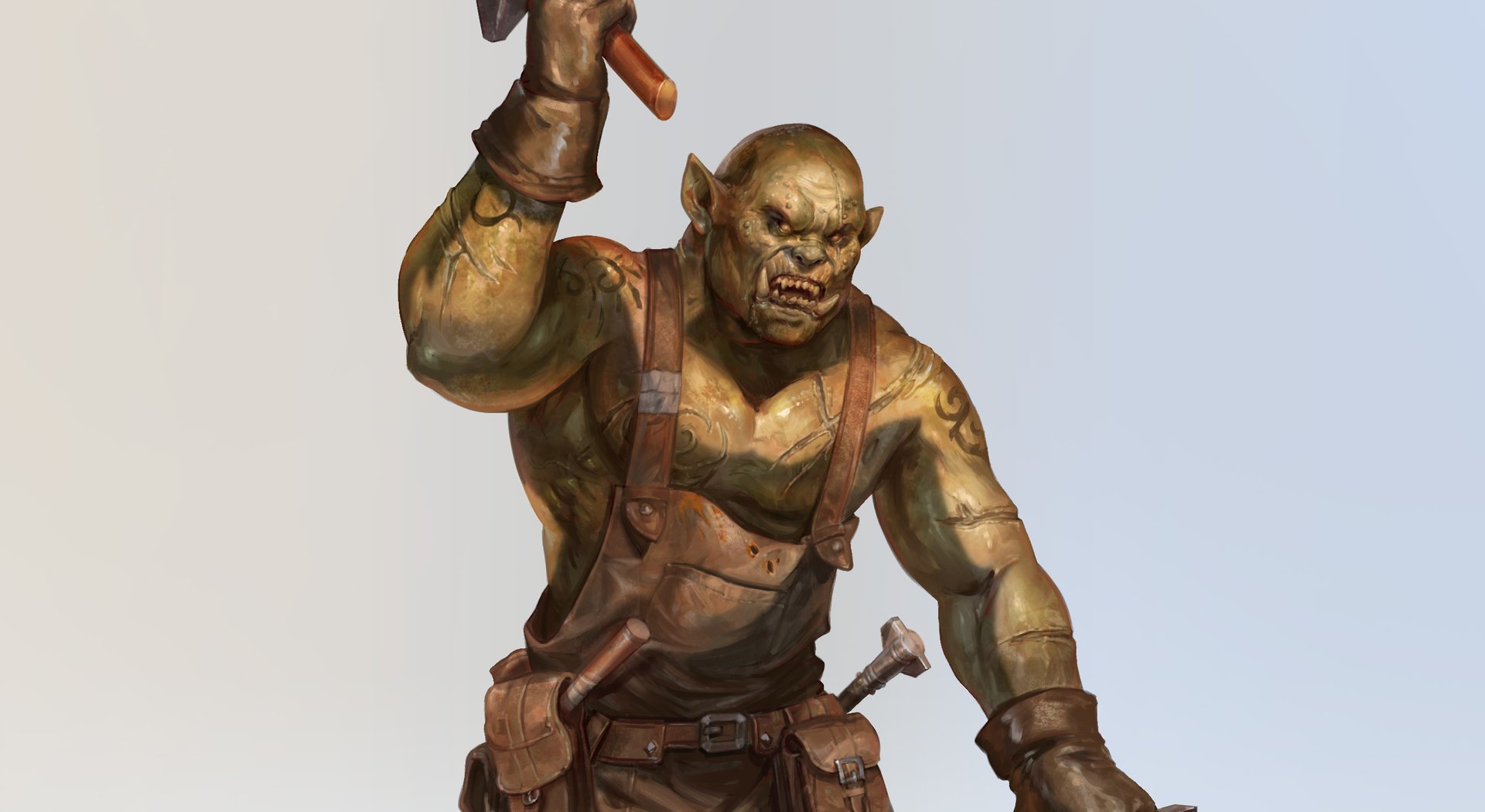
Orcs have large, fierce teeth, with two of the bottom ones rising into tusks, as well as skin of mottled, lush green – a natural camouflage which they developed to survive in the valley jungles. Their features tend to be angular and pronounced, often lacking the gracefulness of the other humanoid races.
At a glance
| Feature | Details |
|---|---|
| Appearance | Green-skinned humanoids with angular features and prominent lower tusks. |
| Origins and communities | Historical roots in Dun Valley; many later served in the Indorani Empire. |
| Culture | Military innovation, forging, weapon design and inherited scarification traditions. |
| Racial abilities | Cunning; Enduring; Might |
Origins and history
The Orcs, like their cousin Ogres, are distantly related to the Trolls, as all three races were created through the machinations of the Goddess of Corruption sometime in the First Mortal Epoch. Originally nomadic hunter-gatherers, the Orcs united with the Ogres to take Dun Valley, fighting back the human tribes that had made their home there and showing their early cunning in war.
During the height of the Indorani Empire, enslaved Orcs formed a significant minority of the imperial military; when their masters’ dynasty collapsed, the Orcs were forever branded with the same reputation of corruption, destruction, and fear that the Children of Despair had commanded.
Craft and warfare
The race has a long history of military innovation; despite their lack of contribution to other fields, it is a common point of contention whether an Orc or a Dwarf first invented a particular forging technique or produced the prototype of some common weapon. It is true that owing to the nature of their creation, Orcs have typically favoured a more destructive, warlike approach, through which their not-inconsiderable cunning has filtered, but conversion to the Light has tempered this tendency somewhat.
Scarification
Men of the Orc race are distinguished, in many cases, by ritual scarification. Scars endured in battle are often incorporated into the design. Designs tend to be passed down through families, although scars signifying wisdom, priesthood, and other honoured vocations are often added alongside family patterns. Scarification begins young, and its completion – often involving the administration of the most painful scars – signifies a man’s coming of age.
Though Ogre men also follow this practice, the two races possess differing designs. This practice dates to the Indorani empire, when marks upon the flesh and corporal punishment were common; Orcs and Ogres, often called upon to punish their own, found resonance with Rahnite philosophy. The practice thus endured beyond the fall of the Indorani, and is still widely employed in the diaspora despite objections from more contemporary Dunnite philosophy.
Racial abilities
Level 1: Cunning
Syntax: CUNNING SELECT <weapon>
CUNNING SHOW
Gain proficiency in a single weapon of your choice. Do note that it cannot be changed or undone, so choose wisely.
See HELP PROFICIENCY for more information.
Level 31: Enduring
This ability is passive.
Your endurance is unmatched by other races, increasing your maximum endurance by 5%.
Level 61: Might
This ability is passive.
No race is more mighty than you in physical combat. When dealing brute-sourced damage, it increases by 1%.
Class ideas for roleplay
These are potential starting points for a character’s story and are offered as suggestions only. You can make almost any class or race combination work in Aetolia as your race gives no special advantage with these classes; availability follows the usual class and guild rules.
Carnifex
An Orc weaponsmith could take their people’s military inventiveness into the Carnifex’s armouries and training grounds. Service to Bloodloch would put halberds, mauls and warhounds to the test in a tradition that treats destruction and the culling of weakness as its work.
Templar
An Orc who rejects the legacy of the Indorani Empire could bring their knowledge of arms to Enorian. Templar service would ask them to pursue justice under a chivalric code, giving inherited martial traditions a purpose opposed to Corruption and Tyranny.
Ravager
An Orc brawler might leave formal military discipline behind to join Bloodloch’s Ravagers. Fighting dirty, drawing on Perdition’s soulfire and wielding their own ego would make victory and carnage more important than a well-ordered battle line.
See also: The Races of Aetolia · The World of Aetolia · Character Classes