Game updates, world events, and news from Aetolia - delivered to your inbox.
Name Please enter your name. Email Please enter a valid email address.Unsubscribe at any time via the link at the bottom of any email.
The Runecarver of Aetolia
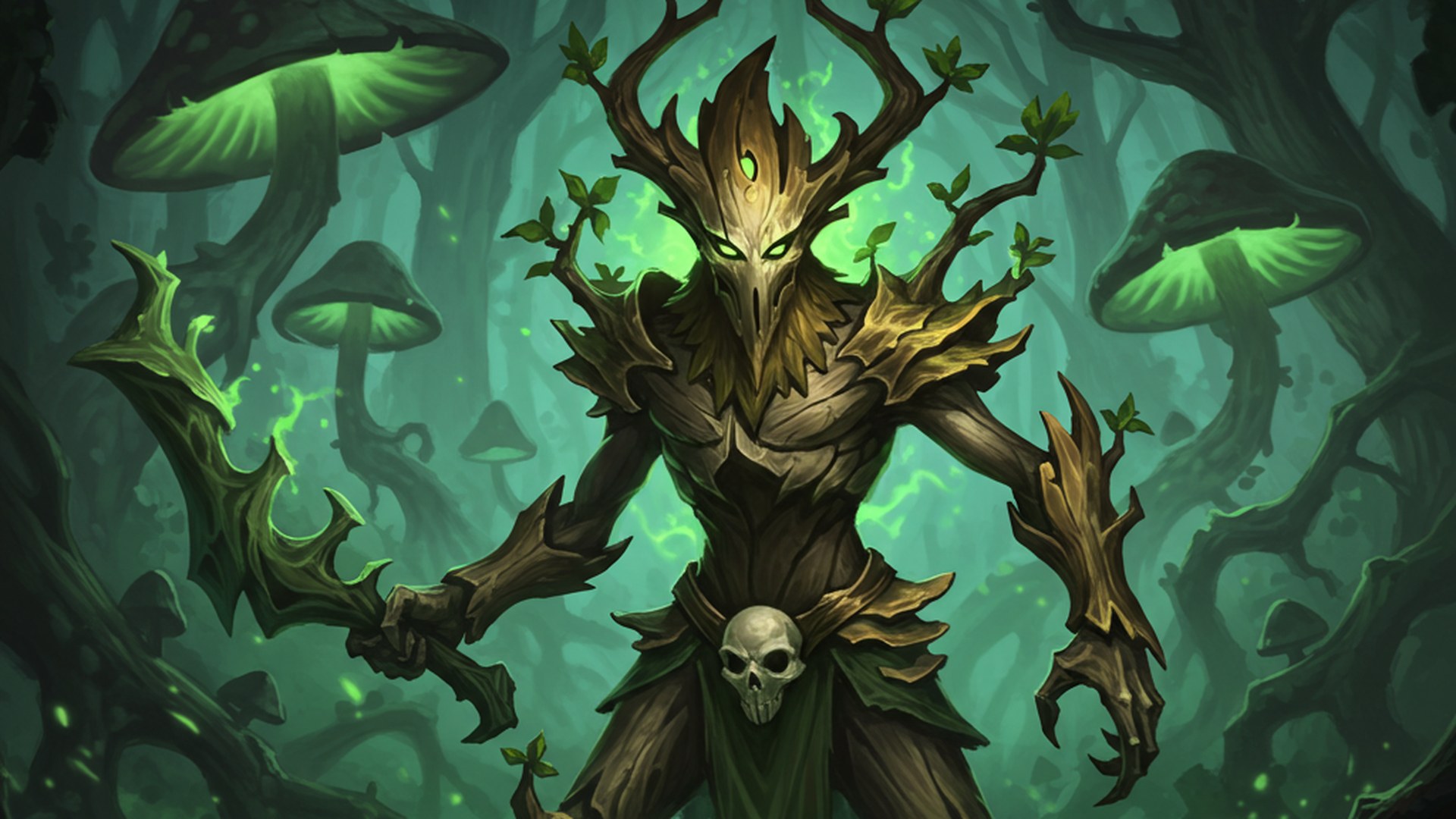
The Runecarvers are Aetolia’s priests of mortality, decay, and rot, a Spirit-tethered class in Duiran that wields Malediction (curses sworn under pact with Dia’ruian Guardians), Runecarving (primitive runic magic from the tribal Ithmia), and Sporulation (fungal shamanism cultivated from living spore morasses).
| At a glance | |
|---|---|
| Tether | Spirit |
| City | Duiran |
| Guild | Praadi (Patron: Haern, the Hunter) |
| Skill sets | Malediction, Runecarving, Sporulation |
| Mirror class | Sciomancer (Shadow) |
| Sister classes in guild | Shaman and Sylvan |
| Signature mechanic | Pacts with Dia’ruian Guardian spirits, fungal morass cultivation |
| Best for | Players who want a curse-and-decay caster on the Spirit side of the conflict |
The Runecarver is nature’s darker twin. Where the Shaman calls lightning and overgrowth, the Runecarver works with the rot underneath. They curse, they cultivate fungus, they carve runes that draw their power from primal soil and not from any school of civilised sorcery.
Origin and lore
Runecarvers are the third path of the Praadi, alongside the Shaman and the Sylvan. All three serve Dia’ruis (the Plane of Life born in 504) and the eternal Cycle maintained by Varian alongside the Triumvirate of Haern, Dhar, and Lleis.
The Runecarver holds a specific place in that order: priest of mortality, decay, and rot. Without Death, there can be no Life, and the Runecarver tends to the death side of the equation. They form pacts with the more obscure Guardians known to Dia’ruis, including Nivios the Unslaked (an icewyrm), Asheira the Wildfire (a phoenix), Lopaia the Scavenger (a jackal), Z’krell the Festering (linked to rot, decay, and the myconids of Albedos), and several others foreign to mainland Sapience.
The art of Runecarving itself dates back to the tribal Ithmia, kept alive by hunters like Runecarver Rhydderch and circles like the Karnagh. It is older than civilised magic, and the class wears that age.
Skill sets
Malediction is the curse-craft. By attuning to the turn of the Cycle, a Runecarver weaves hexes that plague foes with illness and insanity. Pacts with individual Guardians empower specific rituals.
Runecarving is the primitive runic art. By drawing on ambient power, a Runecarver enlivens runes etched into surfaces or carried, calling on illusions, protective shields, and obscuring fog. It is entirely different from the practices of civilised sorcery (Elemancy, Sciomancy). Its roots reach back to the tribal Ithmia.
Sporulation is fungal shamanism. A Runecarver cultivates a living spore morass that serves as the focal point of the practice. They coax growth by controlling natural heat, moisture, and darkness, and the morass becomes a battlefield asset that spreads life and death in equal measure.
Skill abilities
Malediction
-
Meridian
DescriptionSyntax: CHANNELS
STRADDLE LINEA Runecarver treads the brink between Life and Death, utilising the stray energy left behind in this fundamental Cycle to empower their acts of ritual magic.
Once you have embraced your awareness of its delicate forces, you will be able to make repeated use of hexes. There is no cost to keeping it active and you may divest yourself of your awareness of mortality's delicate inner workings at any time.
-
Maledict
DescriptionSyntax: HEX MALEDICT <target>
HEX MALEDICT ICEWALL [<direction>]Craft a minor curse from your rancor and ill will to strike your foe. The force of this curse can also melt an icewall obstructing a path.
DetailsTarget Location Same location
Damage Type Magic
Damage Source Arcane
Base Damage 100 + 9%
Base Damage (Denizen) 725
Equilibrium Recovery 3.00 seconds
Equilibrium Recovery (Icewall) 4.00 seconds
RequirementsRequires balance and equilibrium.
Costs 100 mana to use.
Costs 25 willpower to use.
Requires at least one arm functional.
RestrictionsConsidered an aggressive action.
Considered a basic attack against denizens.
Cannot be entangled, paralysed, or fallen.
-
Numb
DescriptionSyntax: HEX NUMB <target>
Cast a minor hex of numbing cold, freezing your target by one level.
If you form a pact with the spirits, this ability will freeze them for two levels if they weren't shivering to begin with.
-
Nightsight
DescriptionSyntax: NIGHTSIGHT
See easily through the shadows that surround you.
-
Stalk
DescriptionSyntax: HEX STALK <ON|OFF>
Call upon Kree-sa, the Broodmother to mask your movements. Whenever you attempt to move through a room covered in darkness, your movement will be completely concealed. Lifevision may spot this attempt, but heatvision cannot.
-
Imperil
DescriptionSyntax: HEX IMPERIL <target>
Slice through any magical shield surrounding your target with this curse of vulnerability and peril.
If you form a pact with the spirits, there is no equilibrium cost for this ability if it is successful. Should you fail, you will still be held to the terms of your pact as well as pay the equilibrium cost.
-
Enervate
DescriptionSyntax: HEX ENERVATE <target>
The curse of enervation smothers the vitality of your foe, consuming their good health and physical form alike. When enervating your opponent, you will cause the following afflictions in order, providing that your target has all the previous afflictions, and then also deal magical damage to them.
Afflictions given by enervation in order:
Clumsiness, weariness, and then lethargy.If all three afflictions are present, you will steal away their focus balance (AB SURVIVAL FOCUS) and cause paresis.
If you form a pact with the spirits, your curse will cause two afflictions in order instead of one. If paresis is delivered in this way, no focus knock will be applied.
-
Myconid
DescriptionSyntax: HEX MYCONID
CALL MYCONIDSummon a myconid, a strange fungal monstrosity native to Albedos. This creature can be ordered to attack your enemies, and will periodically cause cold damage and one level of freezing to your target.
If your victim is fully frozen when the myconid strikes, they will be stunned and afflicted with nyctophobia.
Please see HELP LOYALTY for the commands you can order it to do.
-
Jinx
DescriptionSyntax: HEX JINX <target>
Maledictive curses are capable of instilling illnesses of the body and mind, causing both to waste away beneath your wrath. When jinxed, your victim will suffer immediately from one of the following afflictions that they don't already have.
Afflictions jinx can give:
Dizziness, nyctophobia, confusion, dementia.If all four afflictions are present on the target, they will instead be struck with a significant mana drain and faintness.
If you form a pact with the spirits, the jinx will relapse once more five seconds later but with no damage. If your intended victim is no longer in your presence when the relapse occurs, however, you will be jinxed instead to keep balance between the forces you control.
-
Spiritpact
DescriptionSyntax: SPIRITPACT <spell> <target>
Spiritpact is used as a replacement for the normal HEX command.
e.g. SPIRITPACT ENERVATE <target>Empower your curses by forming pacts with the Dia'ruian Guardians. With every successive cast of spiritpact to empower a curse, the risks and rewards increase. For now, you may call upon their aid twice, and not again until the previous pacts are fulfilled.
A pact will be fulfilled after 20 seconds, and will cost a small portion of your health when it occurs. The more afflictions you have when the time comes, the more the health it will be.
Lastly, whenever you manage to kill another adventurer, a pact will be immediately fulfilled.
-
Despair
DescriptionSyntax: HEX DESPAIR <target>
Hex your victim with an ominous curse of despair, giving them an 80% chance to become burdened with phobias any time they focus (see AB SURVIVAL FOCUSING).
The phobias this can afflict with are:
Nyctophobia, agoraphobia, loneliness, vertigo, and claustrophobia.If standing in darkness, nyctophobia is always the first phobia to appear, otherwise it is random.
Attempting to cure despair while you have the courage defence will cause your courage to be stripped. Unlike other afflictions, despair will not be cured until you recover salve balance after applying epidermal.
If you form a pact with the spirits, this may be performed free of any equilibrium cost.
-
Revile
DescriptionSyntax: HEX REVILE <target>
Send a malignant curse of rot to infiltrate your victim, feeding on the hexes you call down upon them. At first, the rot is benign, and has no meaningful effect. However, the rot will grow over time, and its effects too will increase. The rot may grow four times after the first stage.
1) No effect.
2) Their spirit gradually atrophies, causing escalating spirit damage.
3) Their body ceases to generate warmth - preventing random curing of shivering.
4) Their flesh withers under the rot, periodically causing hopelessness.
5) Their body falters - the recovery time from poultices is doubled.This curse may be cured by consuming panacea. If standing outside of the presence of a morass, two stacks will be cured instead of one.
If you form a pact with the spirits, you will deliver two stacks of the curse immediately.
-
Obeisance
DescriptionSyntax: HEX OBEISANCE
Fulfil your pact with an offering of flesh and blood, costing you a moderate amount of health and releasing you from one of your pacts.
You may then continue to use the ability even while it is on cooldown, however the repayment will cost 50% more health and will cost equilibrium to perform.
Using the ability while on cooldown will refresh the cooldown timer.
Cooldown: 10 seconds
-
Implement
DescriptionSyntax: HEX CREATE FOCUS
EMBED SPHERE IN <weapon>Extract a spore from the compost heap in Duiran that will serve to heighten the powers of your cursecraft. The spore must be used to anoint either a staff, a shortsword, or a crozier.
For those unwelcome beneath the eaves of the Heartwood, a second compost heap waits within a fungi circle in the Eastern Ithmias, offering the same boon.
Should you be wielding an anointed object, you will be able to channel your primal magic with greater ease. Your spells will no longer require both hands, only a single hand. Additionally, parrying an attack will charge your implement with magical force, restoring a portion of your mana instantly.
-
Rancour
DescriptionSyntax: HEX RANCOUR <ON|OFF>
The art of Malediction does not cleave to the traditional rigidity of structured spellcasting schools such as Elemancy or Sciomancy and thus allows for improvisation and additional reagents to supplement its power. By channeling raw spite and rancour, you can gather inimical spirits to aid each strike, render your curses nigh irresistable by changing their damage type to spirit. This will cause your attacks to do less overall damage and comes at a slight willpower drain.
-
Renewal
DescriptionSyntax: HEX RENEWAL
Call upon the force of Renewal to draw two random maladies from your body. Should you be suffering from paralysis or paresis, Renewal will always cure that first, and only that.
Cooldown: 20 seconds
-
Mystify
DescriptionSyntax: HEX MYSTIFY <target>
If your target lacks courage, you can mystify them with a terrible curse that distracts them with visions of the void.
This will give them the voidgaze affliction, and will immediately trigger its passive effect. This will trigger even if the opponent already has the voidgaze affliction.
See AFFLICT VOIDGAZE for information on its effects.
If you form a pact with the spirits, your mystify will shatter their heightened sense of courage first before applying it effects.
-
Imitate
DescriptionSyntax: HEX IMITATE <target>
Order your myconid to change its form into a fungal representation of your chosen target. Should the myconid take any damage or attempt to attack someone, this effect will become undone. Can only be done on targets in the room.
-
Preymark
DescriptionSyntax: HEX PREYMARK <target>
Mark your foe as prey, causing elixirs to lose some of their potency, reducing the amount healed to health or mana this way by 20%. The strength of the curse's mark is dependent on how low your victim's mana is - the preymark will never last for fewer than two sips, and no more than five. There is a short channel associated with performing this ability.
If you form a pact with the spirits, your preymark is applied instantly, and for slightly less equilibrium.
-
Malady
DescriptionSyntax: HEX MALADY <target>
Curse your foe with wasting maladies, dealing magical damage to the target.
If they are an adventurer, it will cause vomiting and haemophilia. If they have the dementia affliction, then the malady will drive them mad, curing it and causing hallucinations in its place.
If you form a pact with the spirits, the equilibrium recovery time is much faster.
DetailsTarget Location Same location
Damage Type Magic
Damage Source Arcane
Base Damage 150 + 10%
Base Damage (Denizen) 725
Equilibrium Recovery 2.70 seconds
Equilibrium Recovery (Spiritpact) 2.00 seconds
RequirementsRequires balance and equilibrium.
Costs 50 mana to use.
Costs 30 willpower to use.
Requires at least one arm functional.
RestrictionsConsidered an aggressive action.
Considered a basic attack against denizens.
Cannot be entangled, paralysed, or fallen.
-
Preserve
DescriptionSyntax: HEX PRESERVE
Surround yourself in a protective aura, reducing your damage taken from the elements, and significantly reducing your damage taken from shadow.
Those preserved by the Warden can forge four pacts at once.
-
Woe
DescriptionSyntax: HEX WOE <target>
Call down woe and tribulation upon your foe, subjecting them to the hardships of hunted prey. While suffering this curse, afflictions delivered from Jinx will be masked, and afflictions from Revile cannot be cured.
For each curable affliction plaguing your foe, the woeful curse will last for an extra 2 seconds. Only one rot affliction will increase the timer, others won't count. A victim suffering from nyctophobia will add a bonus 4 seconds.
If you form a pact with the spirits, your woeful hex also delivers nyctophobia, and for slightly less equilibrium.
Cooldown: 30 seconds
-
Assuage
DescriptionSyntax: HEX ASSUAGE <ON|OFF>
Your myconid hungers for the fallen, as befits the Cycle. Should anything die in the same location as your myconid while it is with you, the fungal creature will immediately devour the corpse and restore some willpower to you. An adventurer's corpse will restore a lot more willpower than a denizen's.
There is a small cooldown on this effect occuring, with the length of time dependant on the type of corpse.
Cooldown (denizen): 5 seconds
Cooldown (adventurer): 15 seconds -
Vilipend
DescriptionSyntax: HEX VILIPEND <target>
Manifest your rancor and disdain as a biting curse that periodically saps your foe's mana.
The degrading hex will persist for a short time, but will vanish if your victim leaves your sight.
If you form a pact with the spirits, your curse will persist indefinitely in your presence.
-
Nourish
DescriptionSyntax: HEX NOURISH
In exchange for a significant portion of your physical and mental energy, you may beseech the Guardians to release you from all of your spiritpacts. Be warned that this action will halve your health and mana to perform.
This does not require nor use balance and equilibrium to use.
Cooldown: 20 minutes
-
Anathemise
DescriptionSyntax: HEX ANATHEMISE <target>
Should your victim be afflicted with maladies caused by hexes, you can leverage their weakness to secure victory over them. This hex does nothing on its own, but can have any or all of the following effects depending on what they are afflicted by:
Haemophilia: Causes significant bleeding.
Nyctophobia: Causes significant health and mana damage.
Dizziness: Causes dementia.
Weariness: Causes lameness.If you form a pact with the spirits, one of these missing conditional afflictions will be applied at random before the curse completes.
-
Spite
DescriptionSyntax: HEX SPITE
This ability will call upon the spirits to recognise an oath of spite. Then, when you deal damage and are standing in the location you last died within, your damage will be boosted by fulfillment of your word.
-
Mortis
DescriptionSyntax: HEX MORTIS <target>
Drawing upon your mastered link to the forces of Life and Death, you may call forth a killing curse that will annihilate your foe where they stand.
In order to begin your spell, your victim must be suffering from both nyctophobia and prone, and will require your complete concentration to complete.
Should your attempt be successful without interruption, your victim will be utterly obliterated, and any spiritual pacts you have formed will be immediately fulfilled.
If you form a pact with the spirits, your attempt will be quickened, and more importantly, no force may disrupt it other than your opponent leaving and remaining out of your presence for the duration of the attempt. If this attempt fails, however, your health and mana will be shattered in half to appease the spirits.
Runecarving
-
Branch
DescriptionSyntax: RUNECARVE BRANCH [target]
Create an illusion of yourself or another that will protect you against certain attacks. Each time it is cast, the ability will consume a charge that will take time to recover. Only one charge may recover at a time. Once you use three charges, you will be unable to create any further illusory reflections.
Cooldown: 15 seconds per
-
Ironbark
DescriptionSyntax: RUNECARVE IRONBARK
By fortifying your body with a protective layer of shieldbark, you make it harder for your opponent to land full blows upon you. This defence will grant you a chance to reduce some of the damage taken from physical attacks as a result, as well as afford you a small layer of physical protection.
-
Windwalk
DescriptionSyntax: RUNECARVE WINDWALK
LANDCarve a rune that allows you to walk upon the air.
-
Quarry
DescriptionSyntax: RUNECARVE QUARRY <target> <SKULL|ORB|SQUARE|TRIANGLE|MOON>
Carve a rune that designates your target with a hunting mark, making them visible across the battlefield for some time. The target can then be targetted using the name of the symbol marking them. You can only have one marker in existence at a time.
-
Orison
DescriptionSyntax: RUNECARVE ORISON <10-1000>
Through communion with the wilds, you can replenish your mana reserves. This will deplete your willpower proportional to how much mana you choose to recover.
-
Prowess
DescriptionSyntax: RUNECARVE PROWESS <ON|OFF>
At a small willpower drain, you may manifest your hexes into a more precise form, giving your critical hits a chance to be empowered one step higher.
-
Deceive
DescriptionSyntax: RUNECARVE DECEIVE <illusion>
RUNECARVE DECEIVE AT <target> <illusion>A mainstay of Runecarvers setting ambushes, simple illusions can astound your allies and confound your enemies.
Note: You can add a new line into your illusion by using the tag $nl within the text, however you may only do this once.
-
Unveil
DescriptionSyntax: RUNECARVE UNVEIL HERE
RUNECARVE UNVEIL <aegis> <glyph>
RUNECARVE UNVEIL <glyph>Undo the spellwork that has left any lingering effects in a location. This will not dispel glyphs unless they are specifically targetted, and dispelling your own glyphs will not consume your equilibrium.
You can also cast the dispel upon an aegis to remove the specified glyph from it, though the protective magic of the aegis will make this process take some time.
-
Mysticism
DescriptionSyntax: RUNECARVE MYSTICISM [target]
Uplift your mind with this lunar rune and boost the effects of the moon tattoo upon your mana regeneration. You can additionally supply a target to give someone else this benefit.
-
Enliven
DescriptionSyntax: RUNECARVE ENLIVEN <aegis>
An aegis typically needs to be attuned to the land so that it can draw upon the mana it needs to operate its defences - but a runecarver can circumvent this requirement in a special manner. By giving it a constant supply of mana from your own reserves, you can have the aegis' defences work wherever you happen to be holding it. This is a channeled operation and most other actions will interrupt the process.
-
Majesty
DescriptionSyntax: RUNECARVE DECEIVE [AT <target>] COLOUR:<colour> <text>
While little more than a trick used at campfire gatherings, chromatic illusions can astound those present with vivid color. There is an increase in equilibrium cost for this effect.
-
Lunacy
DescriptionSyntax: RUNECARVE LUNACY <ON|OFF>
So powerful are your deceptive runes, that you may further imbue them with the maddening power of the moon. At an increased cost to the spell itself, your reflection will backlash against all enemies in the room when it expires, draining their mana.
-
Legerdemain
DescriptionThis ability is passive.
You are now adept enough to be able to place a second reflection upon someone with your Branch rune. However, this comes at a far greater cost to your equilibrium.
-
Stormcloud
DescriptionSyntax: RUNECARVE STORMCLOUD <dir>
A variation on the windwalk rune, you can position yourself to fly in a direction of your choice, taking you into the skies above the room in your targeted direction.
-
Horizon
DescriptionSyntax: RUNECARVE HORIZON <illusion>
RUNECARVE HORIZON COLOUR:<color> <illusion>
RUNECARVE HORIZON ON AEGIS <illusion>Form a visual deception from the local energies that will persist for a few minutes before dissipating. Anyone who enters a room with a horizon rune attached to it will see the illusion upon entry. Only one such horizon can exist in the room, and subsequent runes will drain the power from their predecessors.
The horizon can also be attached to an attuned crystal aegis, where it will persist forever or until dispelled. It will only be shown to targets of the aegis in this situation.
The dispel ability can be used to remove a horizon prematurely.
-
Bewitch
DescriptionSyntax: RUNECARVE BEWITCH <target>
This rune will call upon the forestal wisps that will transfix your target and render them incapable of action. If they possess heightened courage, then the ability will fail instead.
Cooldown: 20 seconds
-
Toil
DescriptionSyntax: RUNECARVE TOIL <ON|OFF>
Sketch an empowering rune upon your hand that will multiply your maledictive magic, thus enacting greater harm upon your enemies. Whenever you cast a hex, the rune will flare and lash out at another random enemy, causing shadow damage. Should you stand in darkness, the rune's light will strike an extra enemy with magic damage.
If triggered by the Maledict spell, the toil rune will deal significantly more damage.
When used against adventurers, there is a short cooldown before Toil may strike again.
Cooldown (adventurers): 2 seconds
-
Obfuscate
DescriptionSyntax: RUNECARVE OBFUSCATE
Drawing upon your mastery of runes, you may create an obscuring fog that will mask the presence of all in your location. Such an illusion will not prevent anyone from attacking others should they know they are there. The Unveil or Dispel abilities can counter an obfuscating rune.
-
Attunement
DescriptionSyntax: ATTUNE AEGIS HERE
DAMPEN AEGIS
CEDE AEGIS <org>In an impressive feat of spellcraft, you can embed a crystal aegis into the land around you. By attuning it to the leylines that course all throughout the continent, you can keep the aegis permanently supplied with the energy it needs to keep its defences activated. Such an act takes a considerable length of time, and requires your utmost concentration. Once attuned in place, the aegis cannot be moved. You cannot attune an aegis to a room if there is another attuned aegis already placed within a two-room distance.
An attuned aegis will only have four of its glyphs activated when set up in this state. Within a city, the help of its pylon can further increase it to all six. During a period of stable activity of the leylines however, an attuned aegis will become dormant due to a lack of energy. Please see AB REFINING FLUXATIONS for more information.
To remove an aegis, you can focus on dampening its connection to the leylines. This act will take a much shorter time than attuning, but your utmost concentration is still required. As a mage, you can perform this feat significantly faster than the Survival skill equivalent. Once completed, the crystal aegis will shatter into pieces, destroying it completely.
You can also cede ownership of an aegis to any organisation, so long as the aegis has been attuned upon a location that belongs to that organisation. Cities, however, can hold ownership of up to five aegises beyond their home territory. Once the ownership has been ceded, the aegis will instead attack enemies of that organisation, instead of your personal enemies.
- You can sketch the following runes
-
Runes
DescriptionRunes are mystical symbols sketched through the air with gem dust and infused with mana. Each rune has a different effect depending on the runic script sketched and the gem dust used to create it.
There are currently two types of runes: persistent runes, and triggered runes. Persistent runes will last for a short duration and impose a constant effect upon their location, until they fade from their magic being depleted. Triggered runes will hang in the air until an enemy of yours enters the location, at which point their effect will trigger and the rune will dissipate as its magic depletes. The clarity defence will protect an enemy from being affected by most triggered runes.
Each room can only contain two runes, for any more than that would cause the magics to disrupt each other. Both runes must be different.
Runes can additionally be sketched onto the facet of a crystal aegis, instead of in the air. When upon an aegis, runes will be permanently powered and no longer fade. Some runes may have a different effect when upon an aegis. An aegis can exist alongside runes sketched in the room.
-
Observation
DescriptionSyntax: SKETCH OBSERVATION
SKETCH OBSERVATION ONTO <aegis>Required dust: 1 topaz
Type: TriggeredThe observation rune will alert you when it is triggered, informing you of the location and who did it.
If traced onto an attuned aegis, this rune will alert the owner of the aegis when a caravan passes through its location (HELP PRODUCTION).
If traced onto an attuned aegis that also has its ownership set to an organisation, the observation rune will instead make an alert over that organisation's channel.
-
Portal
DescriptionSyntax: SKETCH PORTAL <target>
SKETCH PORTAL ONTO <aegis>Required dust: 1 topaz
Type: Persistent (room), Triggered (aegis)Sketch the outline of a portal and it will open soon after, leading between you and your target.
If sketched onto an aegis, the portal rune will attack the limbs of your enemy, randomly leaving one crippled.
-
Destruction
DescriptionSyntax: SKETCH DESTRUCTION
SKETCH DESTRUCTION ONTO <aegis>Required dust: 1 ruby
Type: TriggeredThe destruction rune will attack the physical form of your enemy with spears of wild energy, damaging their health.
-
Vainglory
DescriptionSyntax: TRACE VAINGLORY
TRACE VAINGLORY ONTO <aegis>Required dust: 2 topaz
Type: TriggeredThe vainglory rune will cause a surge of grandiosity in your enemy, afflicting them with hubris.
-
Addling
DescriptionSyntax: SKETCH ADDLING
SKETCH ADDLING ONTO <aegis>Required dust: 1 topaz, 1 emerald
Type: TriggeredThe addling rune will corrupt the mind of your enemy, afflicting them with dementia. This rune will work regardless of the clarity defence, and will strip the defence from your target.
If sketched onto an aegis, the addling rune will always be the first rune to fire.
-
Entrapment
DescriptionSyntax: SKETCH ENTRAPMENT
SKETCH ENTRAPMENT ONTO <aegis>Required dust: 2 ruby
Type: TriggeredThe entrapment rune will send magical ropes to entangle your enemy.
-
Slumber
DescriptionSyntax: SKETCH SLUMBER
SKETCH SLUMBER ONTO <aegis>Required dust: 1 diamond
Type: TriggeredThe slumber rune will instill a lulling drowsiness into your enemy as it attempts to put them into a deep sleep.
If sketched onto an aegis, the slumber rune will always be the last rune to fire.
-
Arrogance
DescriptionSyntax: SKETCH ARROGANCE
SKETCH ARROGANCE ONTO <aegis>Required dust: 1 emerald, 1 ruby
Type: TriggeredThe rune of arrogance will bolster your own pride, giving you the egocentrism affliction.
-
Insanity
DescriptionSyntax: SKETCH INSANITY
SKETCH INSANITY ONTO <aegis>Required dust: 1 emerald, 2 ruby
Type: TriggeredThis unique rune will pull at the fabric of the minds of your enemy, instantly afflicting them with both stupidity and confusion.
-
Gravity
DescriptionSyntax: SKETCH GRAVITY
SKETCH GRAVITY ONTO <aegis>Required dust: 1 topaz, 2 emerald
Type: TriggeredThe rune of gravity will pull anybody above the ground elevation back to earth after a short delay. This affects everybody into the room, regardless of enemy status.
After a period of time, the rune will fade on its own if not sketched on an aegis.
-
Labyrinth
DescriptionSyntax: SKETCH LABYRINTH
Required dust: 1 topaz, 1 diamond
Type: TriggeredThis complex rune will form a temporary songline, causing the first enemy to enter its location to be immediately moved to your morass, as long as it is within 10 rooms of the rune. A monolith sigil in either location will prevent this attempt.
Sporulation
-
Germinate
DescriptionSyntax: SPORE GERMINATE
SPORE STATUS
SPORE CULLBy calling upon your link to the natural world, you may manifest a morass of dangerous spores under the command of your shamanic prowess. It will remain where you have summoned it unless moved with other abilities. Almost all abilities in Sporulation will require your morass.
A spore morass is classified into one of five sizes, listed here from smallest to largest:
Inchoate
Festering
Enveloping
Consumptive
PutrefactiveThe larger your morass is, the more damage some abilities will do and the more diverse its strain content can be. An inchoate morass is only large enough to propagate a single strain.
-
Transplant
DescriptionSyntax: SPORE TRANSPLANT
Call your morass back to you by communing with it from afar. This is instant.
-
Carpet
DescriptionSyntax: SPORE CARPET
Your mastery of rot, mould, and fungus allows you to manifest a living carpet of decomposition underfoot. This voracious combination of natural forces is similar to both the levitation and waterwalking defenses.
This technique is one of the few that does not require communion with your living morass.
-
Rot
DescriptionSyntax: SPORE ROT <object>
As a master of decomposition, you can utilise your magic to destroy most objects with but a single touch. This spell is an act of will that you cannot be forced into, and it cannot sufficiently decay permanent objects.
-
Dispersal
DescriptionSyntax: SPORE DISPERSAL
This spell will, after a brief moment of focus, disperse your physical form and return you to your morass in a single breath. Should it be in the same area as you, this will be much faster.
-
Host
DescriptionSyntax: SPORE HOST <object>
SPORE EJECT <object> AT <target>|GROUNDYou may host up to three objects of your choice within mycological growths upon your own physical form. While hosted upon your body, you and you alone may GET <object> to retrieve it free of balance. This method of storage creates a build-up of fungal fluid within the growth's gills that adheres to the object in question, allowing you to eject the object at a target and retract it with a muculent cord. Unfortunately, you do not have enough fine control of these objects to deliver a venom from an edged weapon, but ejecting something at a prone victim will do more damage.
Should you store sigils in this manner, you may eject them at the ground free of any balance.
-
Ensnare
DescriptionSyntax: SPORE ENSNARE <target>
Your shamanic sporulation is so potent that you may manifest a single, rapidly growing clutchgill spore that latches onto a target and knock them down, leaving them fallen, afflicting with paresis, and propagating a single culture. Adding further cultures has a small cooldown, in which repeatedly ensnaring them won't add more.
If a target stands within the darkness that nourishes fungal growth, the spore will instead lash out and drag them to you directly, though doing so will remove a single culture.
Cooldown (culture propagate): 5 seconds
-
Festering
DescriptionSyntax: SPORE GERMINATE
You are now attuned enough to nature and rot that you may germinate a festering morass. A morass of this size may accomodate two fungal strains.
-
Degrade
DescriptionSyntax: SPORE DEGRADE <target> <left/right> <arm/leg>
By consuming all the cultures propagated upon a victim, you may cause limb damage dependent on the amount of cultures present. If five cultures are consumed in this way, the rot will reach the bone and cause significant trauma, becoming broken instantly.
If a target has the preymark branded upon them and at least three spore cultures, the degradation will consume the preymark in place of the cultures.
-
Uplift
DescriptionSyntax: SPORE UPLIFT
Temporarily flood your location with magical spores that draw in ambient air, sending any items, denizens, and adventurers flying into the sky if they do not have the density defence. After a couple of seconds, the spores will deflate, returning the surroundings to normal. As a result, everything will fall back to the ground. The density defence is ignored should someone have five spore cultures present on their body, but this will consume two of those cultures.
When the effect ends, anybody in the sky will be pulled back to the ground. If an adventurer is infested by fungal cultures, they will take damage when they fall back down proportional to the amount of stacks they have.
If you are indoors, adventurers affected will instead be stunned by slamming into the ceiling.
-
Mortify
DescriptionSyntax: SPORE MORTIFY <target>
Direct a stream of flesh-eating spores to pour forth from your morass, causing significant magic damage to a target in your line of sight. If you slay a target in this manner, their body will be drawn into your fungal morass and consumed as nourishment.
The ability Rancour can modify the damage type for this skill. Please see AB MALEDICTION RANCOUR for more information.
-
Enveloping
DescriptionSyntax: SPORE GERMINATE
You are now so skilled in sporulation magic that you manifest a morass that envelops its surroundings. A morass of this size can propagate up to three fungal strains.
-
Infect
DescriptionSyntax: SPORE INFECT <target>
Draw upon your mycological might and infect your foe with an invasive spore that slows their body's functions, increasing their pill recovery balance by a small amount. They must be afflicted by at least one fungal culture for this ability to work. Each time they consume a pill, however, there is a chance that their body will reject a culture, drawing them nearer to a healthy state. Should they purge themselves of all fungal strains, this effect will end prematurely.
If your morass is massive enough to be considered putrefactive, this ability costs no balance or equilibrium to use. You may only infect one target at a time.
-
Burst
DescriptionThis skill is passive.
So long as you have at least one object hosted upon your form, its fungal encasement will periodically burst and spray decomposing fluid upon the last denizen you attack. This substance will eat away at their form, causing minor damage.
-
Omophagia
DescriptionSyntax: SPORE OMOPHAGIA <SPREAD|CONSUME>
Set your dangerous morass free and allow it to creep into everything within your surroundings, where upon it will eventually consume everything in a wave of death and decay.
When you initiate this fell spell, its danger will be obvious to any that stand around you, and the morass will begin expanding. In this state, any strain you have active will cease its effect. The longer you allow the morass to expand, the more powerful its resultant wave will be. When you are ready to unleash its terrible hunger upon your foes, you may order it to consume the flesh of all around you. Should you deny the morass its feast for too long, it will commence consumption on its own.
It's important to note that once this process begins, there is no way to prevent it from completing aside from killing the Runecarver responsible for its formation.
When the feast finishes, your morass will disperse and must be germinated once more. Those who are maledictively mystified (see AB MALEDICTION MYSTIFY) will be helpless to resist and will perish instantly, no matter how long the spores took to spread across the area.
If there is more than five people who can be damaged by the wave, there is a chance that some select few will be too far away from the effect and will be spared.
Those who die through this skill will leave no corpse.
-
Consumptive
DescriptionSyntax: SPORE GERMINATE
You are now adept enough to control a consumptive morass. A morass of this size can support up to four fungal strains.
-
Inoculation
DescriptionSyntax: SPORE INOCULATE <target>
Germinate your target with a magical spore that enhances your maledictive magic. While inoculated, there is a chance with each manifested hex that your victim will suffer an additional spore culture. Each time you cast a spell against your target, the duration will refresh entirely.
If your morass is considered putrefactive, this ability costs no balance or equilibrium to use.
-
Encroach
DescriptionSyntax: SPORE ENCROACH <direction> <4-12>
After a short delay, you may propel your morass in a direction upon a gust of wind. If you are with your morass when this occurs, its magical adhesion will pull you alongside it in whatever direction you choose. You do not need to be on balance or equilibrium for this effect to occur, and the morass will pull you past any who block your path regardless of your physical state. You are made of flesh and blood, however, and thus cannot use this ability to bypass walls or doors.
-
Colonisation
DescriptionSyntax: SPORE COLONISE [<strain1> [<strain2>]...]
Your experience with handling fungal spores is so great that you can now germinate it with a specified list of strains. Should you already have an existing morass, this will instead morph its manifested strains to the specified list.
-
Putrefactive
DescriptionSyntax: SPORE GERMINATE
You are now adept enough to control a putrefactive morass of spores. A morass of this size can propagate up to six different strains.
- Your morass can propagate the following strains
-
Hartsblood
DescriptionSyntax: SPORE HARTSBLOOD <ON|OFF>
Propagate the hartsblood strain within your morass, which will cause your foes to steadily host more and more spore cultures for so long as they stand in its presence. This magical strain may affect a target up to five times. Some sporulation spells will have stronger effects against targets that host spore cultures. The only cure for culture propagation is time.
Hartsblood is a strain of fungal growth that has recently resurfaced after the birth of Dia'ruis. This strain propagates much faster than other fungi and often grows in places of historic battles. It is said to thrive upon blood and acquired its name from the splatters of blood from wounded deer hunted by the ancient Ithmian tribes.
-
Stormstem
DescriptionSyntax: SPORE STORMSTEM <ON|OFF>
Manifest the massive stormstem mushroom's spores within your morass, allowing it to blanket your location in night-like darkness. The larger your morass, the further this tremendous specimen shall reach - a putrefactive morass will extend its darkness up to 3 rooms away.
The stormstem mushroom is known to grow within conjoined, dense structures that spread out like a storm cloud all throughout the forest. Its magical properties allow it to defy and smother light, a natural wonder that other fungi use to prosper beneath its shade. By necessity, the strain also absorbs an equal amount of ambient shadow to sustain its properties per the demand of Dia'ruian equilibrium.
-
Ravencap
DescriptionSyntax: SPORE RAVENCAP <ON|OFF>
Cause your morass to exude the spores of the ravencap mushroom, inducing disorienting, depressive visions in your enemies.
Possible afflictions your ravencap spores can give are:
Stupidity, dizziness, loneliness, or dementia.The ravencap mushroom is also known as the Raven's Bruise. Traditionally, this specific strain is associated with depressive or somber visions undertaken as a rite of passage for shamans of the old Ithmian tribes. In these ancient times, it was often used in old rituals honoring spirits associated with wisdom or self-reflection. After the birth of Dia'ruis and the renewal of the natural world, the mushroom emerged in the wilds once more.
-
Greycrown
DescriptionSyntax: SPORE GREYCROWN <ON|OFF>
Awaken the greycrown strain in your morass, which will periodically cause magical damage to any enemies present. These spores will also occasionally assault the senses, instilling a sense of nausea within the victim and afflicting them with vomiting. The larger your morass, the more often this will occur.
A fungal strain associated with death, the Greycrown is named in honor of He Who Is Death. In the ancient times of the Ithmian tribes and other disparate Duirani people, the mushroom was consumed in small doses during funerary rites of shamanistic figures.
-
Sapmantle
DescriptionSyntax: SPORE SAPMANTLE <ON|OFF>
Imbue your morass with the tramelling secretions of the paralytic sapmantle, hindering the escape of any infected by your spores. While active, anybody with at least one spore culture that attempts to leave the location will incur a delay time dependant on the amount of spores they have.
The sapmantle is a massive fungi that gets its name from a numbing substance it secretes all around its cap and gills. Before the Ithmian tribes gained a rudimentary understanding of toxicology, the sapmantle's fluid was used as a substitute in battle.
-
Furyscale
DescriptionSyntax: SPORE FURYSCALE <ON|OFF>
This strain will increase the stability and regeneration of your morass, causing your omophagia attempts to no longer disperse the spore cloud and instead impose a cooldown on its use. Should your morass disperse due to uncontrollable hunger, it will still be destroyed.
Also known as the Fury's Fang, this strain is known to explode when it grows too large. The resultant burst of spores is how it spreads most often, causing it to reproduce and create entire glades of bursting mushroom patches in the spring and summer seasons.
Cooldown (Omophagia): 10 seconds
-
Rootcrest
DescriptionSyntax: SPORE ROOTCREST <ON|OFF>
By awakening the rootcrest strain, your morass will prevent you from being moved physically, by your own will or otherwise. Magical forms of movement are unaffected by this. While secured, your morass is entirely unable to be moved as well, and you must end the rootcrest's influence to move once more.
A sturdy strain of fungi known to be difficult to entirely extract from the ground, the rootcrest's grip upon the land make it almost as implacable a tripping hazard as large rocks or immovable tree roots.
Visual style and identity
Runecarvers do not perform grand magical displays. Their work is subtler. Most of what others see is subtle. Ritual motions, ancient invocations, the carving of mystic script: ambient energies redirected rather than conjured.
The dark parts of nature heed their call. Fungi sprout and foetid rot manifests at their command. Ritual tension and primal fear clutch the air wheresoever they walk. A Runecarver is an envoy of life and death, growth and regrowth, often garbed in ceremonial raiments, pelts, and other ritual cloth.
Side effects of the work
A Runecarver lives close to the spirits. Many become prone to visions and instinctual living. The constant monitoring of the Cycle pulls them closer to the Rhythm and to a moment-to-moment way of living that civilised people find disorienting.
Association with foul omens makes some Runecarvers more superstitious over time. Many indulge in hallucinogenic mushrooms cultivated from their own Sporulation work, especially when learning to deepen their understanding of the practice. Some elder Runecarvers (particularly Arboreans, whose bark provides ideal substrate) develop fungal growths directly on their own body.
Who plays this class
The Runecarver fits players who want a caster on the Spirit side without the bright, life-affirming overtones of the Shaman. The roleplay frame ranges from terrible witch to wise bonecaster to mushroom-tending hermit, all valid.
Mechanically, the kit rewards setup-and-curse play: stack Maledictions, cultivate the morass, drop runes for utility, then close. Unlike Aetolia’s arcane casters, the Runecarver draws no power from structured sorcery: no planes tapped through study, no channelled elements. The power comes from the Cycle itself: pacts, rot, and primal runes.
City and guild
The Runecarver guild is the Praadi, anchored in Duiran, the Spirit Tether’s forest city. Patron: Haern, the Hunter. Sister classes include the Shaman and the Sylvan.
Joining as a Runecarver commits you to Spirit. You can multiclass into other Spirit classes or any of the seven untethered classes. Race is independent of class, so a Runecarver can be any Aetolia race.
The Runecarver mirrors the Sciomancer, Spinesreach’s masters of the Plane of Shadow. The Runecarver draws on rot and the dark half of the Cycle. The Sciomancer draws on the Plane of Shadow itself, working singularities and gravity.
Frequently asked questions
Other classes to consider
Three classes worth a look if you like the Runecarver profile. Or see all 32 Aetolia classes for the rest of the roster.
Shaman
The Shaman is the Runecarver’s sister class in the Praadi, same guild and same patron, but built around primal elements, lightning, and overgrowth rather than curses and rot. Pick Shaman if you want overt elemental power on the Spirit side.
Sciomancer
The Shadow-side mirror. Direct channel to the Plane of Shadow, singularities, and gravity. Pick Sciomancer if you like the destructive-caster chassis but want to play on the Shadow side as a Spinesreach mage.
Indorani
The Indorani is a Bloodloch dark sorcerer with a similar curse-and-magic profile. Their three skills are Necromancy, Tarot, and Domination, the last of which involves negotiating with Chaos Lords for an army of chaotic entities. Pick Indorani if you like the dark-magic frame but want to swap Dia’ruian rot for chaotic occultism.
Back to all 32 Aetolia classes | Aetolia beginner’s guide | Create your Runecarver and play free